| |
Date |
Event(s) |
| 1 | 1910 | - 6 May 1910—20 Jan 1936: King George V's reign

George V's reign saw the rise of socialism, communism, fascism, Irish republicanism, and the Indian independence movement, all of which radically changed the political landscape. The Parliament Act 1911 established the supremacy of the elected British House of Commons over the unelected House of Lords. As a result of the First World War (1914–1918), the empires of his first cousins Tsar Nicholas II of Russia and Kaiser Wilhelm II of Germany fell, while the British Empire expanded to its greatest effective extent.
In 1917, George became the first monarch of the House of Windsor, which he renamed from the House of Saxe-Coburg and Gotha as a result of anti-German public sentiment. In 1924 he appointed the first Labour ministry and in 1931 the Statute of Westminster recognised the dominions of the Empire as separate, independent states within the Commonwealth of Nations.
|
| 2 | 1923 | - 2 Aug 1923—4 Feb 1929: Calvin Coolidge - 30th US President

John Calvin Coolidge Jr. (July 4, 1872 – January 5, 1933) was an American politician and the 30th president of the United States from 1923 to 1929. In 1920 he was elected vice president of the United States, and he succeeded to the presidency upon the sudden death of Warren G. Harding in 1923.
Elected in his own right in 1924, he gained a reputation as a small government conservative and also as a man who said very little, although having a rather dry sense of humor. Coolidge restored public confidence in the White House after the scandals of his predecessor's administration, and left office with considerable popularity
|
| 3 | 1924 | - 4 Nov 1924—4 Jun 1929: Stanley Baldwin - 57th British Prime Minister

Stanley Baldwin, 1st Earl Baldwin of Bewdley, (3 August 1867 – 14 December 1947) was a British statesman and Conservative Party politician who dominated the government in his country between the world wars. Three times Prime Minister, he is the only British prime minister to have served under three monarchs.
Baldwin's second government saw reforms in areas formerly associated with the Liberal Party. They included industrial conciliation, unemployment insurance, a more extensive old-age pension system, slum clearance, more private housing, and expansion of maternal and childcare. His government also saw the General Strike in 1926 and the Trade Disputes and Trade Unions Act 1927 to curb the powers of trade unions.
|
| 4 | 1926 | - 25 Sep 1926—7 Aug 1930: William Lyon Mackenzie King - (10th) Canadian Prime Minister

William Lyon Mackenzie King (December 17, 1874 – July 22, 1950) was the dominant Canadian political leader from the 1920s through the 1940s. He served as the tenth prime minister of Canada in 1921–1926, 1926–1930 and 1935–1948. He is best known for his leadership of Canada throughout the Second World War (1939–1945) when he mobilized Canadian money, supplies and volunteers to support Britain while boosting the economy and maintaining morale on the home front.
King acceded to the leadership of the Liberal Party in 1919. Taking the helm of a party bitterly torn apart during the First World War, he reconciled factions, unifying the Liberal Party and leading it to victory in the 1921 election. His party was out of office during the harshest days of the Great Depression in Canada, 1930–35; he returned when the economy was on an upswing.
A survey of scholars in 1997 by Maclean's magazine ranked King first among all Canada's prime ministers, ahead of Sir John A. Macdonald and Sir Wilfrid Laurier. As historian Jack Granatstein notes, "the scholars expressed little admiration for King the man but offered unbounded admiration for his political skills and attention to Canadian unity."
|
| 5 | 1928 | - 1928: Votes for Women

The Representation of the People (Equal Franchise) Act 1928 was an Act of the Parliament of the United Kingdom. This act expanded on the Representation of the People Act 1918 which had given some women the vote in Parliamentary elections for the first time after World War I. The 1928 Act widened suffrage by giving women electoral equality with men. It gave the vote to all women over 21 years old, regardless of property ownership. Prior to this act only women over 30 who met minimum property qualifications could vote.
- 6 Apr 1928: James Watson born

James Watson is an American molecular biologist, geneticist and zoologist who co-discovered the molecular structure of DNA. His discovery has been described by other biologists and Nobel laureates as the most important scientific discovery of the 20th C. Crick, Wilkins and Watson discovered the double helix structure of the DNA molecule
- 28 Sep 1928: Discovery of Pennicillin

The effects of penicillium mould were isolated in 1928 by Scottish scientist Alexander Fleming, in his laboratory in the basement of St Mary's Hospital in London (now part of Imperial College). Fleming coined the term "penicillin"
|
| 6 | 1929 | - 1929: Martin Luther King born

MartinLuther King Jr was a leader of the African-American Civil Rights Movement. While fighting injustice meted out to African-Americans, he shunned violence. He used Christian doctrines but he looked towards Mahatma Gandhi’s non-violent movement. He dreamt that one day every human being would be judged by their ability, not skin colour. He died from a white fanatic’s bullet aged 39
- 4 Mar 1929—4 Mar 1933: Herbert Hoover - 31st US President

Herbert Clark Hoover (August 10, 1874 – October 20, 1964) was an American engineer, businessman and politician who served as the 31st president of the United States from 1929 to 1933 during the Great Depression.
A Republican, as Secretary of Commerce in the 1920s he introduced themes of efficiency in the business community and provided government support for standardization, efficiency and international trade. As president from 1929 to 1933, his domestic programs were overshadowed by the onset of the Great Depression. Hoover was defeated in a landslide election in 1932 by Democratic Franklin D. Roosevelt. After this loss, Hoover became staunchly conservative, and advocated against Roosevelt's New Deal policies.
- 5 Jun 1929—7 Jun 1935: Ramsay MacDonald - 58h British Prime Minister

James Ramsay MacDonald FRS (12 October 1866 – 9 November 1937) was a British statesman who served as Prime Minister of the United Kingdom from 1929 to 1935. He was the first Labour Party politician to become Prime Minister, leading minority Labour governments in 1924 and in 1929–31. He headed a National Government from 1931 to 1935, dominated by the Conservative Party and supported by only a few Labour members.
MacDonald's second government was in a stronger parliamentary position than his first, and in 1930 he was able to raise unemployment pay, pass an act to improve wages and conditions in the coal industry (i.e. the issues behind the General Strike) and pass a housing act which focused on slum clearances. In 1931, in the aftermath of the Great Depression, he was forced to form a National Government with the Conservatives and Liberals.
- 4 Sep 1929: The Great Depression

The Great Depression was a severe worldwide economic depression that took place mostly during the 1930s, beginning in the United States. The timing of the Great Depression varied across nations; in most countries it started in 1929 and lasted until the late-1930s. It was the longest, deepest, and most widespread depression of the 20th century.
The Great Depression started in the United States after a major fall in stock prices that began around September 4, 1929, and became worldwide news with the stock market crash of October 29, 1929 (known as Black Tuesday). Between 1929 and 1932, worldwide gross domestic product (GDP) fell by an estimated 15%. By comparison, worldwide GDP fell by less than 1% from 2008 to 2009 during the Great Recession. Some economies started to recover by the mid-1930s. However, in many countries the negative effects of the Great Depression lasted until the beginning of World War II.
|
| 7 | 1930 | - 7 Oct 1930—23 Oct 1935: R. B. Bennett -11th Canadian Prime Minister

Richard Bedford Bennett, 1st Viscount Bennett, (3 July 1870 – 26 June 1947), was a Canadian lawyer, businessman, and politician. He served as the 11th prime minister of Canada, in office from 1930 to 1935. Bennett was born in Hopewell Hill, New Brunswick, and grew up in nearby Hopewell Cape.
He served in the Legislative Assembly of the Northwest Territories from 1898 to 1905, and later in the Alberta Legislature from 1909 to 1911. He was the inaugural leader of the Alberta Conservative Party from 1905, resigning upon his election to the House of Commons in 1911. Bennett became prime minister after the 1930 election, where the Conservatives won a landslide victory over Mackenzie King's Liberal Party. He was the first prime minister to represent a constituency in Alberta.
The main difficulty during Bennett's prime ministership was the Great Depression. He and his party initially tried to combat the crisis with laissez-faire policies, but these were largely ineffective. However, over time Bennett's government became increasingly interventionist, attempting to replicate the popular "New Deal" enacted by Franklin Roosevelt to the south. This about-face prompted a split within Conservative ranks, and was regarded by the general public as evidence of incompetence. Bennett consequently suffered a landslide defeat at the 1935 election, with Mackenzie King returning for a third term.
|
Webmaster Message
I make every effort to document my research. If you have something you would like to add, please contact me.

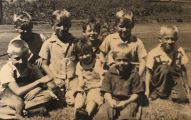

 1927 - 1930 (3 years)

