| |
Date |
Event(s) |
| 1 | 1952 | - 6 Feb 1952—8 Sep 2022: Queen Elizabeth II's reign

Elizabeth II (21 April 1926 – 8 September 2022), became head of the Commonwealth and queen regnant of seven independent Commonwealth countries: the United Kingdom, Canada, Australia, New Zealand, South Africa, Pakistan, and Ceylon on 6 Feb 1952.
She reigned through major constitutional changes, such as devolution in the UK, Canadian patriation, and the decolonisation of Africa. Her many historic visits and meetings include a state visit to the Republic of Ireland and visits to or from five popes. Significant events have included her coronation in 1953 and the celebrations of her Silver, Golden, and Diamond Jubilees in 1977, 2002, and 2012 respectively. In 2017, she became the first British monarch to reach a Sapphire Jubilee. She is the longest-lived and longest-reigning British monarch as well as the world's longest-reigning queen regnant and female head of state, the oldest and longest-reigning monarch and the longest-serving head of state.
|
| 2 | 1979 | - 4 May 1979—28 Nov 1990: Margaret Thatcher - 71st British Prime Minister
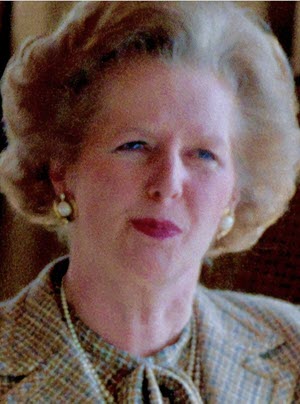
Margaret Hilda Thatcher, Baroness Thatcher, (née Roberts; 13 October 1925 – 8 April 2013) was a British stateswoman who served as Prime Minister from 1979 to 1990. She was the longest-serving British prime minister of the 20th century and the first woman to hold that office. A Soviet journalist dubbed her "The 'Iron Lady'", a nickname that became associated with her uncompromising politics and leadership style.
Thatcher introduced a series of economic policies intended to reverse high unemployment and Britain's struggles in the wake of the Winter of Discontent and an ongoing recession. Her policies emphasised deregulation, flexible labour markets, privatisation of state-owned companies, and reducing the power of trade unions. Her popularity waned amid recession and rising unemployment, but victory in the 1982 Falklands War and the recovering economy brought a resurgence of support. She survived an assassination attempt in the Brighton hotel bombing in 1984.
Thatcher was re-elected for a third term in 1987, but her subsequent support for the Community Charge ("poll tax") was widely unpopular, and her views on the European Community were not shared by others in her Cabinet. She resigned in November 1990, after a leadership challenge.
|
| 3 | 1980 | - 3 Mar 1980—30 Jun 1984: Pierre Trudeau - (15th) Canadian Prime Minister

Joseph Philippe Pierre Yves Elliott Trudeau (October 18, 1919 – September 28, 2000) was a Canadian statesman who served as the 15th prime minister of Canada (1968–1979 and 1980–1984). He was the third longest-serving prime minister in Canadian history (behind William Lyon Mackenzie King and John A. Macdonald), having served for 15 years, 164 days.
Trudeau became a media sensation, inspiring "Trudeaumania", and took charge of the Liberals in 1968. From the late 1960s until the mid-1980s, his personality dominated the political scene to an extent never before seen in Canadian political life. Despite his personal motto, "Reason before passion", his personality and political career aroused polarizing reactions throughout Canada.
His eldest son, Justin Trudeau, became the 23rd and current Prime Minister as a result of the 2015 federal election and is the first prime minister of Canada to be a descendant of a former prime minister
|
| 4 | 1981 | - 20 Jan 1981—20 Jan 1989: Ronald Reagan - 40th US President

Ronald Wilson Reagan (February 6, 1911 – June 5, 2004) was an American politician who served as the 40th president of the United States from 1981 to 1989. Prior to his presidency, he was a Hollywood actor and union leader before serving as the 33rd governor of California from 1967 to 1975.
Soon after taking office, Reagan began implementing sweeping new political and economic initiatives. His supply-side economic policies, dubbed "Reaganomics", advocated tax rate reduction to spur economic growth, economic deregulation, and reduction in government spending. In his first term he survived an assassination attempt, spurred the War on Drugs, and fought public sector labor.
Foreign affairs dominated his second term, including ending the Cold War, the bombing of Libya, the Iran–Iraq War, and the Iran–Contra affair. He transitioned Cold War policy from détente to rollback by escalating an arms race with the USSR while engaging in talks with Gorbachev. The talks culminated in the INF Treaty, which shrank both countries' nuclear arsenals.
|
Webmaster Message
I make every effort to document my research. If you have something you would like to add, please contact me.


 1983 - 1983 (0 years)

