| |
Date |
Event(s) |
| 1 | 1910 | - 6 May 1910—20 Jan 1936: King George V's reign

George V's reign saw the rise of socialism, communism, fascism, Irish republicanism, and the Indian independence movement, all of which radically changed the political landscape. The Parliament Act 1911 established the supremacy of the elected British House of Commons over the unelected House of Lords. As a result of the First World War (1914–1918), the empires of his first cousins Tsar Nicholas II of Russia and Kaiser Wilhelm II of Germany fell, while the British Empire expanded to its greatest effective extent.
In 1917, George became the first monarch of the House of Windsor, which he renamed from the House of Saxe-Coburg and Gotha as a result of anti-German public sentiment. In 1924 he appointed the first Labour ministry and in 1931 the Statute of Westminster recognised the dominions of the Empire as separate, independent states within the Commonwealth of Nations.
|
| 2 | 1916 | - 6 Dec 1916—19 Oct 1922: David Lloyd George - 53rd British Prime Minister

David Lloyd George, 1st Earl Lloyd-George of Dwyfor, (17 January 1863 – 26 March 1945) was a British statesman and Liberal Party politician. He was the final Liberal to serve as Prime Minister of the United Kingdom.
As Chancellor of the Exchequer (1908–1915) during H. H. Asquith's tenure as Prime Minister, Lloyd George was a key figure in the introduction of many reforms which laid the foundations of the modern welfare state. His most important role came as the highly energetic Prime Minister of the Wartime Coalition Government (1916–22), during and immediately after the First World War. He was a major player at the Paris Peace Conference of 1919 that reordered Europe after the defeat of the Central Powers.
|
| 3 | 1921 | - 4 Mar 1921—2 Aug 1923: Warren G. Harding - 29th US President

Warren Gamaliel Harding (November 2, 1865 – August 2, 1923) was the 29th president of the United States from 1921 until his death in 1923, a member of the Republican Party.
At that time, he was one of the most popular U.S. presidents, but the subsequent exposure of scandals that took place under his administration such as Teapot Dome eroded his popular regard, as did revelations of an affair by Nan Britton, one of his mistresses. In historical rankings of the U.S. presidents, Harding is often rated among the worst.
- 29 Dec 1921—28 Jun 1926: William Lyon Mackenzie King - 10th Canadian Prime Minister

William Lyon Mackenzie King (December 17, 1874 – July 22, 1950) was the dominant Canadian political leader from the 1920s through the 1940s. He served as the tenth prime minister of Canada in 1921–1926, 1926–1930 and 1935–1948. He is best known for his leadership of Canada throughout the Second World War (1939–1945) when he mobilized Canadian money, supplies and volunteers to support Britain while boosting the economy and maintaining morale on the home front.
King acceded to the leadership of the Liberal Party in 1919. Taking the helm of a party bitterly torn apart during the First World War, he reconciled factions, unifying the Liberal Party and leading it to victory in the 1921 election. His party was out of office during the harshest days of the Great Depression in Canada, 1930–35; he returned when the economy was on an upswing.
A survey of scholars in 1997 by Maclean's magazine ranked King first among all Canada's prime ministers, ahead of Sir John A. Macdonald and Sir Wilfrid Laurier. As historian Jack Granatstein notes, "the scholars expressed little admiration for King the man but offered unbounded admiration for his political skills and attention to Canadian unity."
|
| 4 | 1922 | - 23 Oct 1922—22 May 1923: Bonar Law - 54th British Prime Minister
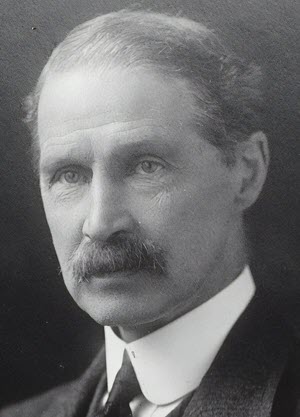
Andrew Bonar Law (16 September 1858 – 30 October 1923), commonly called Bonar Law was a British Conservative politician who served as Prime Minister of the United Kingdom from 1922 to 1923
Bonar Law was the shortest-serving PM of the 20th century. He is often referred to as "the unknown Prime Minister", not least because of a biography of that title by Robert Blake; the name comes from a remark by Asquith at Bonar Law's funeral, that they were burying the Unknown Prime Minister next to the Tomb of the Unknown Soldier. Sir Steven Runciman is reported to have said that he had known all British Prime Ministers in his lifetime, except Bonar Law whom no one knew.
|
| 5 | 1923 | - 22 May 1923—22 Jan 1924: Stanley Baldwin - 55th British Prime Minister

Stanley Baldwin, 1st Earl Baldwin of Bewdley, (3 August 1867 – 14 December 1947) was a British statesman and Conservative Party politician who dominated the government in his country between the world wars. Three times Prime Minister, he is the only British prime minister to have served under three monarchs.
Upon Bonar Law's resignation due to health reasons in May 1923, Baldwin became Prime Minister and Leader of the Conservative Party. He called an election on the issue of tariffs and lost the Conservatives' parliamentary majority, after which Ramsay MacDonald formed a minority Labour government.
- 2 Aug 1923—4 Feb 1929: Calvin Coolidge - 30th US President

John Calvin Coolidge Jr. (July 4, 1872 – January 5, 1933) was an American politician and the 30th president of the United States from 1923 to 1929. In 1920 he was elected vice president of the United States, and he succeeded to the presidency upon the sudden death of Warren G. Harding in 1923.
Elected in his own right in 1924, he gained a reputation as a small government conservative and also as a man who said very little, although having a rather dry sense of humor. Coolidge restored public confidence in the White House after the scandals of his predecessor's administration, and left office with considerable popularity
|
Webmaster Message
I make every effort to document my research. If you have something you would like to add, please contact me.


 1922 - 1923 (0 years)

